What is the Rarest Enneagram Type? Data Reveals Truth
The Enneagram test has become a popular tool for self-discovery, helping millions understand their core motivations and personalities. A common question echoes through online forums and discussions: which Enneagram type is truly the rarest? For years, many have claimed it's the Type 4, The Individualist, but this has been based more on anecdotal evidence than solid data.
This speculation ends today. Using a massive, anonymized dataset of over 100,000 test results from Enneagramtest.me, we are ready to set the record straight. We will explore the actual distribution of the nine types and discuss what this information really means for your personal growth journey. The answer might surprise you.
Understanding type distribution is a fascinating piece of the puzzle, but the most crucial step is discovering your own unique profile. To begin your journey, you can always start our free test and gain initial insights into your personality.

Uncovering Type Distribution: What Our Data Shows
Instead of relying on theories or old assumptions, we turned to our own data for answers. Analyzing a large pool of test results gives us a unique and modern snapshot of how Enneagram types appear among those actively seeking to understand themselves. This data-driven approach allows us to move beyond myths and focus on facts.
Our Research Methodology
Our comprehensive Enneagram test was administered to over 100,000 users, providing valuable insights into type distribution. This large, anonymized dataset allows us to analyze self-reported personality traits on a massive scale, offering a clear and factual basis for our findings.
Complete Enneagram Type Distribution Map
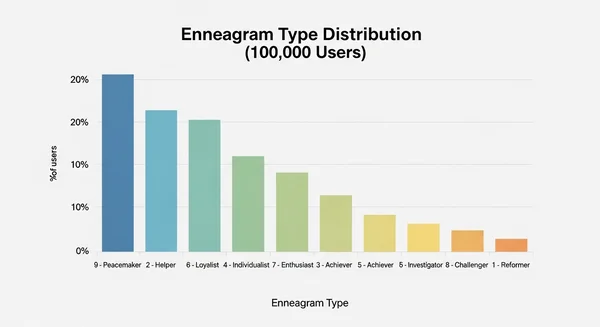
We compiled results from over 100,000 users. A clear picture then emerged about type distribution. Our data reveals a specific hierarchy of type prevalence. While every type is an essential part of the whole, some appear more frequently than others.
Here is the breakdown of Enneagram types from most to least common, based on our findings:
- Type 9 - The Peacemaker: Appeared most frequently, known for their desire for internal and external peace.
- Type 6 - The Loyalist: A close second, characterized by their need for security and support.
- Type 2 - The Helper: Highly common, driven by their need to be needed and loved.
- Type 4 - The Individualist: Often thought to be the rarest, but our data places it in the upper-middle range.
- Type 7 - The Enthusiast: Motivated by a desire to be satisfied and avoid pain.
- Type 1 - The Reformer: Driven by a need to be good, right, and balanced.
- Type 3 - The Achiever: Defined by their desire to be valuable and worthwhile.
- Type 8 - The Challenger: Known for their need to be in control of their own lives and destiny.
- Type 5 - The Investigator: Our data shows this type is the rarest, characterized by a desire to be capable and competent.
This ranking provides a modern, data-backed answer to a long-standing question in the Enneagram community.
Surprising Findings: Beyond Common Assumptions
The most significant surprise from our data is that Type 5, The Investigator, is the rarest Enneagram type, not Type 4. This contradicts a popular and widespread belief. Type 4s, while unique in their emotional depth, are actually more common than Types 1, 3, 8, and 5.
Why does the myth about Type 4 persist? It could be linked to the core identity of the type itself. Type 4s often feel fundamentally different from others. This internal feeling of being an outsider may have fueled the "rarest type" narrative. In reality, their prevalence is much higher than assumed.
Meanwhile, Type 5s, with their tendency to withdraw and observe from a distance, may be less visible in public discussions. Their focus on conserving energy and acquiring knowledge makes them naturally more private, which could contribute to their statistical rarity in self-reported tests. Discovering your own type is the first step, and our accurate Enneagram test can help you find your place on this map.
Why Rarity Doesn't Equal Value in the Enneagram System
It's natural to be curious about which type is the rarest, but it's crucial to remember that rarity does not imply superiority or specialness. The Enneagram is a non-hierarchical system. Each of the nine types represents a distinct, equally valid way of navigating the world, with its own unique strengths, challenges, and path to growth.
Fixating on being a "rare" type can be a distraction from the true purpose of the Enneagram: fostering self-awareness and compassion. Every type contributes something vital to the human experience.
Cultural Influence on Type Perception
How we perceive and identify with Enneagram types can be shaped by our cultural environment. For example, societies that value achievement and success might see a higher self-identification with Type 3, The Achiever. Conversely, cultures that emphasize community and service may find Type 2, The Helper, more prominent.
The perception of rarity can also be influenced by these cultural values. A type that is less aligned with a society's dominant ideals might be perceived as rarer simply because its traits are less celebrated or encouraged. This highlights the importance of looking beyond simple labels and understanding the deeper motivations that define your type.
Understanding Your Type's Unique Strengths
Instead of focusing on how common or rare your type is, a more productive approach is to explore its inherent strengths. Every Enneagram type has a set of powerful gifts.
- Type 1s bring integrity and a desire for improvement.
- Type 2s offer empathy and selfless support.
- Type 3s inspire with their drive and ambition.
- Type 4s provide emotional depth and creativity.
- Type 5s contribute with their wisdom and objectivity.
- Type 6s build trust with their loyalty and preparedness.
- Type 7s spread joy with their optimism and curiosity.
- Type 8s protect others with their strength and decisiveness.
- Type 9s create harmony with their accepting and peaceful nature.
Knowing your type helps you recognize and nurture these strengths. It’s a journey that starts with one simple action: taking a comprehensive online Enneagram test to discover your core personality.
How to Find Your True Enneagram Type Beyond Statistics
The statistics about Enneagram type distribution are interesting. However, they only tell a small part of your personal story. Finding your true Enneagram type requires introspection, honesty, and moving beyond simple descriptions. Your type is determined by your core motivation—the underlying why behind your actions—not just your behavior.
A reliable test can provide a strong starting point, but the real work begins when you use that result to explore your inner world.
Moving Beyond Stereotypes
One of the biggest pitfalls in Enneagram work is relying on stereotypes. You might read a description of a Type 8 and think, "I'm not aggressive, so I can't be an 8," or assume all Type 2s are people-pleasers. These are one-dimensional caricatures.
Every person is a unique individual. Your Enneagram type doesn't put you in a box; it gives you a map to understand the landscape of your inner world. A healthy Type 8 is protective and just, not necessarily confrontational. A self-aware Type 2 knows how to set boundaries. The key is to look at the core fears and desires that drive you, which are often more subtle than surface-level traits.
The Power of Self-Observation and AI Analysis
The best way to confirm your type is through honest self-observation. Pay attention to your automatic reactions, your daydreams, and what causes you stress. What do you seek most in life? What do you fear most? Answering these questions truthfully is the foundation of accurate typing.
To aid this process, modern tools can offer deeper insights. Our free test provides a solid foundation, but for those seeking more, our optional AI-powered analysis offers a new level of personalization. This advanced report goes beyond a basic type description. It analyzes your unique responses to create a detailed profile that includes your wings, strengths, challenges, and a tailored action plan for growth. This combination of a reliable Enneagram type test and advanced analysis empowers you to see yourself with greater clarity.

Your Journey to Self-Discovery Begins Here
So while our data reveals that Type 5 is the rarest Enneagram type, these numbers only tell part of your personal story. We've learned from our research that every type is valuable and unique. What makes the Enneagram truly powerful isn't in categorizing people, but in guiding you toward greater self-understanding and authentic growth.
Your personal journey is what truly matters. It's about discovering your core motivations, embracing your strengths, and navigating your challenges with compassion. Taking the Enneagram test is the first step toward understanding your core motivations and embracing your unique strengths. Ready to explore your unique Enneagram profile?
Take our free test today and unlock deeper insights with our optional AI-powered analysis.
Frequently Asked Questions About Enneagram Type Distribution
What is the rarest Enneagram type according to recent data?
Based on an analysis of over 100,000 anonymized test results from our platform, the rarest Enneagram type is Type 5, The Investigator. This is followed by Type 8 and Type 3. This finding challenges the common assumption that Type 4 is the rarest.
How accurate are online Enneagram tests for determining type rarity?
The accuracy depends on the test's quality and the size of the dataset. Our data comes from a large and diverse user base, providing a reliable snapshot of type distribution among those actively taking an Enneagram assessment. However, remember that these statistics reflect a sample population and are best used for informational purposes, not for diagnosing your own type.
Does being a rare Enneagram type make me special?
No. In the Enneagram system, all nine types are considered equally valuable and valid. Rarity is a statistical observation, not a measure of worth. The goal of the Enneagram is to foster self-awareness and understanding for all types, not to create a hierarchy. Each type has its own unique gifts and challenges.
Can my Enneagram type change over time?
According to traditional Enneagram theory, your core type is fixed from a young age as it is based on your fundamental motivation. However, your behavior can and should change as you grow. A healthy individual will integrate positive traits from other types and become more balanced, but their core fear and desire remain the same.
How does the Enneagram type distribution vary across different cultures?
While there is limited large-scale, cross-cultural research, it is likely that type distribution sees some variation. Cultural values that emphasize certain traits (like achievement in some cultures or community in others) may lead to a higher prevalence of corresponding types. However, all nine types are believed to be universal expressions of human nature. The best way to understand your own place is to begin your discovery with a personal test.