Self Preservation Enneagram 5 Compatibility: Relationships, Marriage, and Growth
Self preservation Enneagram 5 compatibility is less about finding one perfect type and more about understanding how a private, resource-conscious Five builds trust. A self-preservation Five often protects time, space, energy, and emotional bandwidth carefully. In love, that can look steady, loyal, thoughtful, and deeply observant, but it can also feel distant when a partner needs frequent reassurance. If you are exploring your type with a structured Enneagram self-discovery tool, use this guide as a relationship lens, not a fixed verdict. The goal is to see what helps a self-preservation 5 stay connected without feeling invaded.
What Makes a Self-Preservation 5 Different in Love?
A Type 5 usually manages life through observation, knowledge, and internal preparation. The self-preservation subtype adds a stronger focus on shelter, privacy, practical security, and limited demands. Many people describe this pattern as a need for a safe inner or outer "base" where they can restore themselves before engaging again.
In relationships, this can create a quiet kind of devotion. A self-preservation 5 may remember a partner's preferences, solve problems behind the scenes, research practical options, or create a calm home environment. Their love language may not be dramatic emotional display; it may be reliability, competence, uninterrupted time, or careful attention.
The challenge is that the same protective strategy can make intimacy feel risky. Requests may land as demands. Surprise plans may feel like intrusion. Emotional conversations may require a long processing window. A partner can misread the Five's pause as indifference, while the Five may experience the partner's urgency as pressure.
Compatibility improves when both people understand the pattern: the self-preservation 5 is usually not trying to reject closeness. They are trying to prevent depletion. A healthy relationship gives them room to regulate without letting withdrawal become the only answer.
Self-Preservation 5 Compatibility Patterns by Partner Need
No Enneagram pairing is automatically good or bad. Still, self preservation enneagram 5 compatibility often depends on how each partner handles space, reassurance, conflict, and shared responsibility.
Partners who value independence may feel naturally compatible with a self-preservation 5. Type 1, Type 4, Type 5, Type 6, and Type 9 partners can sometimes appreciate depth, steadiness, private rhythms, and thoughtful conversation. The risk is that two withdrawn or careful people may avoid difficult talks for too long.
Partners who lead with warmth, action, or intensity can also be compatible, but the relationship needs clearer agreements. Type 2 may bring emotional generosity that helps the Five soften, while the Five may bring steadiness that helps the Two feel taken seriously. Type 3 may add momentum and practical ambition. Type 7 may bring play and freshness. Type 8 may bring directness and protection. In each case, the gift can become friction if it arrives too fast or too forcefully.
The better question is not "Which type is most compatible with Enneagram 5?" It is "Can both people respect different nervous-system speeds?" A self-preservation 5 often needs slower entry into emotion, clear expectations, and permission to return after taking space. Their partner often needs signs that space is not abandonment.
For readers still sorting out core type, subtype, or wing, an Enneagram test for reflective type exploration can give a useful starting point before relationship analysis becomes too specific.
Best Matches Are Built Around Boundaries, Not Type Labels
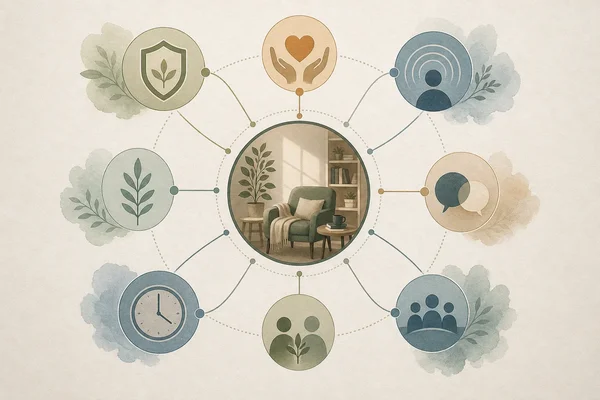
The healthiest match for a self-preservation 5 is usually someone who can honor boundaries without disappearing emotionally. That partner does not need to be detached. They need to be clear, patient, and self-responsible.
A compatible partner can say, "I want to talk about this tonight. Would after dinner work?" instead of launching a heavy conversation while the Five is already drained. They can ask for reassurance directly without framing every pause as proof of rejection. They can enjoy independence while still naming their emotional needs.
The Five also has work to do. Boundaries are not a substitute for participation. If a self-preservation 5 only protects privacy but never shares preferences, hopes, worries, or affection, the relationship becomes a guessing game. Their growth edge is not to become constantly available. It is to become more visible in small, sustainable ways.
Useful compatibility signs include:
- Both people can discuss alone time without shame.
- Plans and expectations are stated instead of implied.
- Conflict has a return time, not an endless silence.
- The Five's privacy is respected, and the partner's need for warmth is respected.
- Practical support and emotional support are both valued.
When these agreements exist, many type combinations can work. Without them, even a supposedly "ideal" pairing can feel lonely.
Common Enneagram 5 Relationship Problems for SP5 Partners
The most common self-preservation 5 relationship problems come from mismatched interpretations. A Five may think, "I am conserving energy so I can stay steady." Their partner may feel, "You are shutting me out." Both experiences can be real.
One problem is silent retreat. Taking time to think can be healthy, but disappearing without context makes the partner anxious. A better version is a time-bound pause: "I need an hour to think, and I will come back after dinner." That single sentence protects the Five's space and the partner's trust.
A second problem is under-asking. Self-preservation 5s may minimize needs because depending on others feels costly. Over time, this can create a hidden imbalance. The partner may not know what the Five wants, and the Five may quietly resent how much they have adapted. Naming one small preference a day is a simple growth practice.
A third problem is intellectualizing emotion. The Five may explain the relationship instead of being emotionally present in it. Analysis can be valuable, especially during conflict, but a partner may also need plain feeling words: "I felt overwhelmed," "I missed you," or "I care, and I am still sorting out my reaction."
A fourth problem is confusing privacy with secrecy. A self-preservation 5 does not need to share every thought. But in marriage or long-term partnership, major decisions, money concerns, health worries, and emotional distance cannot stay permanently behind a wall. Compatibility grows when privacy has boundaries and partnership has shared visibility.

Self-Preservation 5w4, Social 5, and SX5: Why Subtype Changes the Relationship
Searches like self-preservation 5w4, social 5 Enneagram, and sx5 Enneagram point to a real issue: not all Fives relate the same way. Core Type 5 describes a central pattern, but wing and instinct change the flavor.
A self-preservation 5w4 may appear more emotionally textured, creative, and private. They may want deep connection, but only with people who respect their inner world. In compatibility, the partner needs to avoid pushing for performance or instant vulnerability. Gentle curiosity works better than interrogation.
A social 5 may invest more in knowledge communities, ideals, expertise, or meaningful groups. They can seem more outwardly engaged, but intimacy may still be filtered through shared interests or conceptual language. A partner may connect best by entering a meaningful topic and then gradually bringing the conversation back to lived experience.
An sx5, sometimes called a one-to-one Five in broader Enneagram discussions, may seek intense selective bonding. They may look less detached when focused on one person, but still need trust, autonomy, and careful pacing. The compatibility risk is idealizing depth while avoiding ordinary daily maintenance.
These distinctions matter because a partner may be compatible with one Five's rhythm and overwhelmed by another's. Instead of using subtype as a box, use it as a map for better questions: What kind of closeness feels safe? What kind feels consuming? What helps each person return to connection?
A Practical Compatibility Checklist for Marriage and Long-Term Relationships
Self preservation enneagram 5 compatibility in marriage depends on repeated habits, not just initial chemistry. A long-term partner needs to know how the Five manages energy, and the Five needs to know how the partner receives love.
Use this checklist as a conversation starter:
- How much alone time restores you, and when does it become avoidance?
- What topics need advance notice before a serious conversation?
- How will we signal affection when one of us is tired?
- What decisions must always be shared, even if one person prefers privacy?
- How long can a conflict pause last before we set a return time?
- What does practical support look like for each of us?
- What does emotional support look like for each of us?
For many self-preservation 5s, marriage works best when the home feels calm rather than chaotic, shared routines are predictable but not rigid, and affection is expressed in forms that do not always require high emotional intensity. This might mean quiet companionship, parallel projects, scheduled check-ins, thoughtful acts of service, or honest but contained conversations.
The partner's needs matter just as much. If the other person needs frequent verbal reassurance, physical affection, shared social life, or quick emotional repair, those needs should not be dismissed as "too much." The work is to translate needs into doable requests. "Tell me one thing you appreciate today" is easier to answer than "Why are you never emotionally available?"
When to Use an Enneagram Test as a Conversation Starter
An Enneagram framework can help couples name patterns without turning them into permanent labels. If you suspect you or your partner may be a self-preservation 5, use the idea gently. Ask whether the pattern fits. Notice what feels useful and what does not. Leave room for personal history, culture, attachment patterns, stress, and individual choice.
The Enneagram is also not a clinical assessment. Questions about autism, anxiety, trauma, or any mental health concern deserve qualified professional support, especially if daily functioning or safety is affected. A Type 5 description can overlap with traits such as privacy, intense interests, or social fatigue, but overlap is not the same as a health explanation.
For relationship growth, the best use of self preservation enneagram 5 compatibility is practical reflection. Let it help you ask better questions, set kinder boundaries, and build rituals of return after space. If you want a starting point for type exploration, a calm Enneagram test starting point can support the conversation without deciding the relationship for you.

FAQ
What is Enneagram 5 most compatible with?
Enneagram 5 is often compatible with partners who respect independence, communicate clearly, and do not treat alone time as rejection. Some Fives pair well with steady or independent types, while others grow with warmer or more active partners. The strongest predictor is not the partner's number alone. It is whether both people can balance space, reassurance, and honest repair.
What is the self preservation Five Enneagram?
The self-preservation Five is a Type 5 pattern focused on conserving energy, protecting privacy, maintaining practical security, and limiting unnecessary demands. In relationships, this subtype may be loyal and observant but slow to open up. They often need a safe base, predictable expectations, and permission to process before responding.
Are Enneagram 5 autistic?
Being an Enneagram 5 does not mean someone is autistic. Type 5 is a personality framework, while autism is a neurodevelopmental condition assessed by qualified professionals. Some surface traits, such as social fatigue or intense interests, may sound similar, but they can have different causes. Avoid using an Enneagram type as a clinical explanation.
Why are Type 5s so rare?
Type 5 may appear rare in some surveys because fewer people identify with its withdrawn, analytical, and resource-conserving style. However, rarity claims depend on the sample, the test method, and how people understand themselves. It is better to use Type 5 descriptions for self-awareness than to treat rarity as proof that a type is special or fixed.
How does a self-preservation 5 show love?
A self-preservation 5 may show love through reliability, thoughtful problem-solving, remembering details, respecting a partner's boundaries, creating a peaceful home, or sharing carefully chosen parts of their inner world. They may not always lead with expressive emotion, so partners often need to notice quieter signals while still asking for the warmth they need.
Can a self-preservation 5 have a successful marriage?
Yes. A self-preservation 5 can build a strong marriage when both partners make agreements about space, emotional check-ins, conflict repair, and shared responsibilities. The Five usually needs room to recharge, while the partner may need visible signs of care. Compatibility grows when both needs are named without blame.