Free Enneagram Test for Teams: Boost Workplace Dynamics & Leadership
Are you a leader trying to get a group of talented individuals to function as a truly cohesive team? You might notice communication gaps, hidden tensions, or simply a sense of untapped potential. As a leadership coach, I've seen firsthand how teams transform when they start speaking the same personality language. What if there was a key to unlock a deeper understanding of what motivates each person?
This personality framework is a powerful tool that offers unparalleled insights into individual motivations, communication styles, and stress responses. It moves beyond simple personality traits to reveal the core drivers behind why people do what they do. This guide will equip team leaders and HR professionals with actionable strategies to leverage these insights for a more collaborative, productive, and engaged workplace. The first step to this transformation is simple: a journey of self-discovery that can begin with our free personality test.

Why Type Insights Elevate Your Workplace
Integrating this framework into your team's culture is not about putting people in boxes. It's about giving them a shared language to understand themselves and their colleagues on a more meaningful level. This shared understanding is the foundation for a healthier and more effective work environment, directly impacting everything from daily collaboration to long-term growth.
Understanding Diverse Motivations for Better Collaboration
Every member of your team is driven by a unique set of core motivations and fears. For instance, a Type Three team member is motivated by success and wants to feel valuable, while a Type Six is motivated by security and seeks reassurance. Without this insight, a Type Three's push for efficiency can feel bossy to a Type Six. Meanwhile, the Type Six's caution might look like foot-dragging to the Type Three.
When a team understands these underlying drivers, collaboration transforms. Instead of friction, there is empathy. Team members learn to appreciate different perspectives and can adapt their approach to work more effectively with others, leading to smoother workflows and more innovative problem-solving.
Unlocking Team Strengths & Identifying Growth Areas
This system brilliantly illuminates the natural strengths and potential challenges of each type. A Type One brings meticulous attention to detail, a Type Seven brings infectious enthusiasm and creativity, and a Type Nine brings a calming, diplomatic presence. As a leader, knowing this allows you to build a well-rounded team and assign roles that play to individual strengths.
Equally important, it helps identify potential growth areas. It provides a non-judgmental framework for performance feedback and professional development. By understanding their type's typical blind spots, employees are empowered to work on them proactively, supported by a leader who truly gets their core challenges.
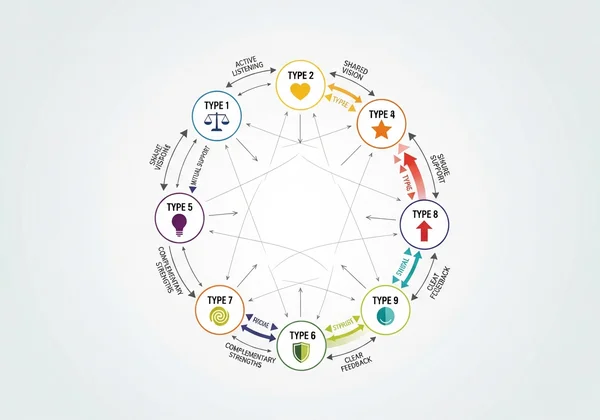
Practical Strategies for Team Building with Type Insights
Understanding the theory is one thing; putting it into practice is what creates real change. Using this personality framework for team building provides a practical toolkit for enhancing communication, optimizing roles, and fostering a culture of mutual respect.
Tailoring Communication: Speak Your Team's Language
Miscommunication is one of the biggest drains on team productivity. This framework offers a guide to tailoring your communication for maximum impact with each type.
- When speaking to a Type 1 (The Reformer): Be logical, precise, and focus on quality and doing things the right way.
- When speaking to a Type 4 (The Individualist): Acknowledge their unique perspective and connect the work to a deeper sense of purpose.
- When speaking to a Type 8 (The Challenger): Be direct, confident, and get straight to the point. Avoid beating around the bush.
When you tweak your style a bit, your message lands better. Misunderstandings drop, and trust grows.
Crafting Roles & Responsibilities Based on Type Strengths
Once you have insight into your team's personality types, you can start to align roles and responsibilities with their natural talents. This isn't about rigid assignments, but about optimizing for engagement and success. A detail-oriented Type Five, for example, may thrive in a research or data analysis role, while a people-oriented Type Two might excel in a client-facing or team support position.
This strategic alignment leads to greater job satisfaction, as employees feel they are using their best skills. It also boosts overall team performance, as each part of a project is handled by the person naturally best suited for it. The journey begins when each member can discover their type.
Facilitating Engaging Team Workshops & Exercises
Introducing this system through a team workshop can be a powerful bonding experience. Start by having everyone take an assessment to discover their type. From there, you can facilitate simple exercises.
One effective activity is to break into small groups and have team members discuss: "What does your Enneagram type need to feel supported and do its best work?" and "What is one common misconception about your type?" This fosters incredible empathy and gives colleagues practical ways to support each other better.

Leadership with the Enneagram: Guiding Your Team to Peak Performance
This framework isn't just a tool for understanding your team; it's a powerful mirror for your own leadership style. By understanding your own personality type, you can identify your leadership strengths, recognize your blind spots, and learn how to adapt your approach to motivate every member of your team effectively.
Leading with Empathy: Motivating Each Type
Effective leadership requires connecting with your team on a human level. The Enneagram provides a roadmap for leading with empathy. If you are a Type Eight leader who values directness, you might learn to soften your approach when giving feedback to a more sensitive Type Four or Nine. If you are a Type One leader focused on process, you can learn to give a creative Type Seven more freedom to innovate.
This level of awareness allows you to become a more versatile and effective leader—one who can provide tailored motivation and support, ensuring every team member feels seen, valued, and inspired to contribute their best work.
Navigating & Resolving Team Conflict with Type Awareness
Conflict is inevitable, but how it's handled determines whether it weakens or strengthens a team. Workplace fights often clash core fears. Take a Type Five: they pull back to save energy. Others might see it as uncooperative. A Type Two’s unsolicited help might feel intrusive, but it comes from a deep-seated need to be needed.
With type awareness, you can depersonalize conflict. You can help your team see that disagreements are often not personal attacks but rather a collision of different worldviews and motivations. This perspective transforms conflict from a destructive force into an opportunity for deeper understanding and growth.
Real-World Scenarios: The Enneagram in Action
Let's look at how these insights play out in common workplace situations. Theory is valuable, but seeing this system in action demonstrates its true power to solve everyday challenges.
Bridging Gaps: Understanding Opposing Types in Collaboration
Imagine a project team with a fast-paced, results-driven Type Three manager and a thoughtful, risk-averse Type Six analyst. The Type Three wants to move quickly, while the Type Six wants to question every detail to ensure security. This can easily lead to frustration on both sides.
A leader who understands personality types can coach them. They can explain to the Type Three that the Type Six's questions are a sign of engagement, not resistance. They can reassure the Type Six that their due diligence is valued while setting clear deadlines to meet the Type Three's need for progress. This turns potential conflict into a powerful partnership that balances speed with quality.
Cultivating Growth: Supporting Individual & Team Development
This framework is a dynamic system that offers a clear path for growth for each type. For example, the growth path for a conflict-avoidant Type Nine involves learning to assert their own opinions and priorities. The growth path for a perfectionistic Type One involves learning to embrace flexibility and self-compassion.
As a leader, you can use this knowledge to support the long-term development of your employees. When you know an employee's type, you can provide challenges and feedback that directly support their growth journey. For truly deep and actionable growth plans, our AI-powered reports offer personalized insights that go far beyond basic type descriptions.
Empower Your Team with Enneagramtest.me Insights
Building a high-performing team begins with understanding the individuals who form it. The Enneagram offers a profound, empathetic, and practical framework for unlocking your team's hidden potential, improving communication, and leading with greater impact. By moving beyond surface-level behaviors to understand core motivations, you can create a workplace where every member feels understood, valued, and empowered to succeed.
Time to level up your team's dynamic? Get your people started on their journey of self-discovery. Encourage them to take our comprehensive and free Enneagram test today and see what insights are waiting to be unlocked.

Frequently Asked Questions: The Enneagram for the Workplace
How can this system specifically benefit my team's dynamics?
This framework directly improves team dynamics by:
- Enhancing Communication: It provides a common language for team members to express their needs and understand others.
- Reducing Conflict: It helps depersonalize disagreements by revealing the underlying motivations and fears that drive behavior.
- Improving Collaboration: When team members appreciate each other's strengths and perspectives, they work together more effectively.
- Boosting Engagement: Employees who feel understood and valued by their leaders and peers are more motivated and engaged.
What are the main Enneagram types I'll encounter in a team setting?
In any team, you'll find a mix of the nine types, each bringing a unique energy. You might have the principled and organized Type 1, the supportive and people-pleasing Type 2, the ambitious and efficient Type 3, the creative and expressive Type 4, the analytical and perceptive Type 5, the loyal and prepared Type 6, the enthusiastic and optimistic Type 7, the decisive and assertive Type 8, and the agreeable and diplomatic Type 9. A balanced team leverages the strengths of all these types.
How do I accurately identify my team members' Enneagram types?
The only accurate and ethical way is for individuals to discover their own type. The Enneagram is a tool for self-discovery, not for labeling others. The best approach is to provide them with a reliable resource and encourage them to explore it for themselves. A great starting point is a well-designed online Enneagram test, which gives them a private and insightful experience.
Is it worth investing in a comprehensive Enneagram assessment for my entire team?
While a free test provides a crucial starting point by identifying a likely type, a comprehensive assessment offers a much greater return on investment. The free result tells you the "what." A premium, in-depth report—like the unique AI-Personalized Reports offered by our AI-powered tool—tells you the "so what" and "now what." It provides actionable, tailored advice on growth paths, communication strategies, and stress management for each individual, saving leaders time and providing a clear roadmap for team development.