Enneagram Typing: How to Identify Your Core Type Without Mistyping
Enneagram typing is the process of identifying the core pattern behind your personality, not just picking the type description that sounds flattering or familiar. A good typing process looks at motivation, attention, coping habits, and what tends to happen under stress. If you are comparing Type 9, Type 5, Type 7, Type 4, Type 1, or any of the nine types, the goal is not to lock yourself into a label. It is to build a clearer self-reflection map. A structured Enneagram typing test can be a useful starting point, especially when you pair the result with careful reading and real-life examples.

What Enneagram Typing Really Means
Many people first meet the Enneagram through an enneagram test, a free enneagram test, or a short list of traits. Those can help, but typing is broader than trait matching. The Enneagram describes nine recurring personality strategies, each organized around a core concern. Two people may share the same behavior but have different reasons for doing it. One person works hard to be responsible because they want integrity and order; another works hard because achievement feels tied to worth. The visible action can look similar while the inner pattern differs.
That is why accurate self-typing usually asks three questions. What do you habitually pay attention to? What do you avoid feeling or facing? What strategy do you rely on when you want safety, connection, or control? These questions help move the process from "which description sounds like me today" toward "which pattern keeps showing up across situations."
The result should stay flexible. Your Enneagram type is not a fixed verdict about your character, and it should not replace professional support when you are dealing with serious mental health concerns. Used well, it is an educational framework for noticing patterns and choosing more intentional responses.
The 9 Enneagram Types at a Glance
The nine Enneagram types are often introduced through names, but the names are only shorthand. A stronger typing process looks beneath the label.
- Type 1, often called the Reformer, tends to organize around integrity, improvement, and doing things the right way.
- Type 2, the Helper, often focuses on being needed, supportive, and emotionally connected.
- Type 3, the Achiever, often moves toward success, efficiency, and a valued image.
- Type 4, the Individualist, often seeks identity, emotional depth, and authenticity.
- Type 5, the Investigator, often protects energy through knowledge, privacy, and independence.
- Type 6, the Loyalist, often tracks risk, trust, preparedness, and reliable support.
- Type 7, the Enthusiast, often pursues options, stimulation, and freedom from limitation.
- Type 8, the Challenger, often values strength, directness, autonomy, and protection.
- Type 9, the Peacemaker, often seeks inner steadiness, harmony, and reduced conflict.

These descriptions are useful, but they can also cause mistyping if you stop there. For example, Type 9 enneagram patterns can look calm, kind, or easygoing, yet the core issue is not simply being peaceful. It is the tendency to maintain steadiness by merging, postponing, or minimizing personal priorities. Enneagram Type 5 may look introverted, but the deeper pattern is often about conserving inner resources and staying competent. Type 7 may look optimistic, but the pattern often includes avoiding limitation or painful focus. Type 4 may look creative, but the key issue is identity and longing, not creativity alone.
How to Type Yourself in the Enneagram
Start with broad exploration, then narrow carefully. Read all nine types before choosing one. Many people jump to the type that feels exciting, admirable, or familiar from a friend. Instead, look for the description that feels quietly accurate, including the parts you would rather not over-identify with.
Next, compare motivation rather than mood. Ask what is usually underneath your actions when you are tired, rejected, praised, interrupted, or given authority. The Enneagram is most useful when it explains repeated inner logic. If your answer changes every week, you may be tracking mood or current stress instead of type.
Then use evidence from several contexts. A person may act differently at work, with family, in conflict, and when alone. The core type should still make sense across those settings, even if it appears in different forms. To support this reflection, an Enneagram self-discovery tool can help you gather structured prompts before you decide which type deserves deeper reading.
Finally, give yourself time. A first result is a hypothesis. Keep notes for a week or two: what you notice, what triggers you, what you avoid, and what feels surprisingly accurate. The right type often becomes clearer when you watch your attention in real life instead of trying to solve it in one sitting.
Common Reasons People Mistype Themselves
Mistyping usually happens for understandable reasons. The first is behavior matching. You may choose Type 1 because you are organized, Type 5 because you like learning, or Type 7 because you enjoy fun. Those traits can be real, but they do not prove the type. The better question is why the behavior matters so much.
The second reason is ideal-self bias. Some descriptions sound more attractive than others. A person may prefer to see themselves as unique, strong, helpful, wise, or easygoing. Self-typing requires honesty about the patterns that create friction as well as the strengths you value.
The third reason is stress. Under pressure, people can appear unlike their usual selves. A normally steady person may become reactive. A normally energetic person may withdraw. A normally thoughtful person may become controlling. If you type yourself during an intense season, compare your current behavior with long-term patterns.
The fourth reason is overlap between neighboring ideas. Wings, subtypes, growth points, and stress patterns can make one type resemble another. For example, Enneagram Type 4 wing 5 and Enneagram Type 5 wing 4 can both appear introspective, but one tends to organize around identity and emotional significance while the other tends to organize around knowledge, boundaries, and inner resources.

A Practical Enneagram Typing Checklist
Use this checklist when you are comparing two or three possible types.
- Write down your top two possible types and one type you strongly resist considering.
- For each type, list the core fear, core desire, and typical coping strategy in your own words.
- Add three examples from real situations, not personality adjectives.
- Notice which type explains both your strengths and your repeated stuck points.
- Ask whether the type still fits when you are not performing, helping, pleasing, arguing, or protecting yourself.
- Revisit wings only after the core type feels reasonably clear.
The most revealing question is often this: "What problem am I repeatedly trying to solve?" Type 2 may try to solve disconnection by becoming useful. Type 3 may try to solve worth by performing well. Type 6 may try to solve uncertainty by scanning for what could go wrong. Type 8 may try to solve vulnerability by staying strong and direct. These are simplified examples, but they show why motivation matters more than surface style.
You can also compare language. A likely Type 9 may say, "I do not know what I want yet, but I do not want conflict." A likely Type 1 may say, "I cannot relax until this is correct." A likely Type 7 may say, "I need options so I do not feel trapped." These phrases are not rules; they are reflection clues.
What an Enneagram Typing Test Can and Cannot Do
An Enneagram typing test online can speed up the discovery process by asking many structured questions and scoring patterns you might miss on your own. A longer test can also reduce the risk of over-weighting one mood or one favorite description. That is especially helpful if you are new to the system and still learning the differences among all Enneagram personality types.
Still, a test should be treated as a guide, not a final authority. Your answers may be influenced by stress, self-image, culture, wording, or how well you understand the questions. A free Enneagram typing test can point you toward likely types, but the strongest result comes from combining the score with reading, journaling, and real examples from your life.
This is also where reports and deeper explanations can help. A basic result may name your likely type. A more detailed report can explain wings, stress and growth patterns, strengths, challenges, and action steps. The value is not simply knowing a number. The value is learning how the pattern appears in everyday choices.
Using Your Type for Growth, Not a Box
Once you have a likely type, use it as a starting point for better choices. Enneagram typing is most helpful when it leads to a small practice: pausing before an automatic reaction, naming a fear, asking for what you need, setting a boundary, or choosing a healthier response under stress.
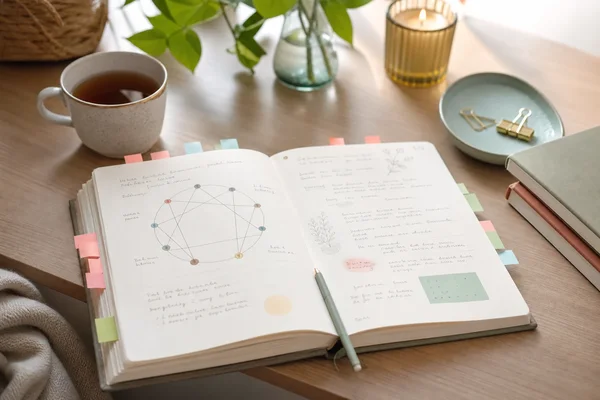
Try one simple reflection exercise. At the end of the day, write three short notes: what caught my attention, what I avoided, and what I chose instead. Over time, this shows whether your suspected type is actually explaining your patterns. It also keeps the Enneagram grounded in growth rather than identity performance.
If you want a structured place to begin, you can explore a guided Enneagram test experience and then return to your notes with curiosity. Let the result open a conversation with yourself, not close it. The best Enneagram work makes you more honest, more flexible, and more compassionate toward the patterns you are learning to change.
FAQ
How do I find my Enneagram type?
Start by reading all nine type patterns, then compare motivations rather than traits. A test can give you a shortlist, but your final choice should make sense across work, relationships, conflict, stress, and private moments. Look for the pattern that explains both your strengths and your repeated friction points.
How do I type myself in Enneagram without overthinking it?
Limit your first comparison to two or three likely types. Write real examples for each one, especially moments when you felt threatened, unseen, restricted, criticized, or responsible. If one type explains your inner logic more consistently than the others, treat it as your working hypothesis.
What are the 9 Enneagrams?
The nine Enneagram types are commonly called Type 1 Reformer, Type 2 Helper, Type 3 Achiever, Type 4 Individualist, Type 5 Investigator, Type 6 Loyalist, Type 7 Enthusiast, Type 8 Challenger, and Type 9 Peacemaker. The names are shorthand; the deeper typing work focuses on core motivations and coping strategies.
Is an Enneagram typing test free?
Many sites offer a free Enneagram test or a free starting result. Free tools can be useful for initial exploration, especially if they ask enough questions to compare multiple types. For deeper interpretation, some platforms also offer optional expanded reports.
Can my Enneagram type change over time?
Your habits, maturity, and behavior can change a lot over time, but Enneagram theory usually treats core type as a stable pattern of motivation. What changes is how consciously you relate to that pattern. Growth can make the type feel less restrictive because you have more choices.
What is Elon Musk's Enneagram type?
Public figures are often typed by fans or commentators, but that kind of typing is speculative unless the person has shared a careful self-assessment. It is better to use celebrity examples lightly and focus your own typing on your direct motivations, relationships, and repeated patterns.