Enneagram Triads Explained: Head, Heart, Gut, Stances, and Harmonics
Enneagram triads are one of the easiest ways to make the nine types feel less like nine separate labels and more like a connected system. Instead of memorizing every type at once, triads group the types into sets of three that share a center of attention, a stress pattern, or a way of moving through relationships. If you are still identifying your core type, an Enneagram test for self-reflection can offer a starting point, but triads help you read the result with more nuance. They are not a clinical assessment; they are a practical language for noticing how you process emotion, conflict, attention, and growth.

What Are Enneagram Triads?
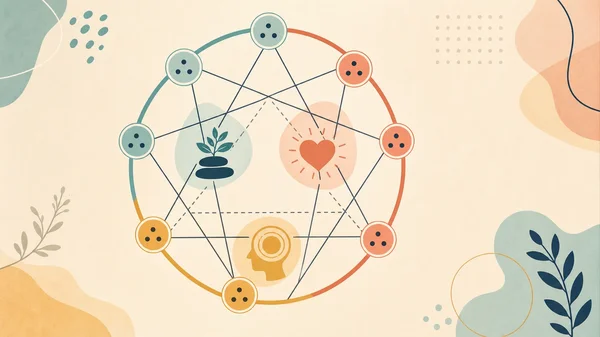
In the Enneagram, a triad is a group of three types that share a meaningful pattern. The most familiar version is the centers of intelligence: the gut triad, heart triad, and head triad. These are often explained as instinct, feeling, and thinking centers.
Triads matter because they show what types have in common before you study what makes each type distinct. Type 8, Type 9, and Type 1 are different personalities, but all three tend to process life through instinct, autonomy, boundaries, and anger. Type 2, Type 3, and Type 4 are different from one another, yet all three are especially alert to image, worth, connection, and shame. Type 5, Type 6, and Type 7 vary widely, but each has a strong relationship with thinking, security, planning, and fear.
That is the main value of enneagram triads explained simply: they give you a map of shared patterns without flattening the nine types into stereotypes.
The Three Centers: Gut, Heart, and Head
The classic enneagram triads head heart gut framework groups the nine types by the center they often rely on first. In practice, every person can think, feel, and act from instinct. The triad points to the center that tends to become most charged, defended, or overused.
| Center triad | Types | Main question | Common emotional theme |
|---|---|---|---|
| Gut or instinctive triad | 8, 9, 1 | How do I maintain autonomy, boundaries, and right action? | Anger |
| Heart or feeling triad | 2, 3, 4 | How am I seen, valued, and connected? | Shame |
| Head or thinking triad | 5, 6, 7 | How do I find safety, certainty, or possibility? | Fear |
Gut Triad Enneagram Types: 8, 9, and 1
The gut triad Enneagram pattern is about instinct, boundaries, and the body-level sense that something is safe, fair, intrusive, or out of alignment. These types often react quickly to pressure, even when the reaction is quiet or controlled.
Type 8 tends to move toward force and directness. Type 9 often moves toward peace, merging, or avoidance of disruption. Type 1 usually moves toward correction, restraint, and principled action. The shared growth question is not "How do I get rid of anger?" but "How can I listen to anger without letting it run the whole system?"
Heart Triad Enneagram Types: 2, 3, and 4
The heart triad Enneagram pattern is about identity, image, connection, and worth. These types often notice the emotional field between people quickly. They may sense approval, disappointment, belonging, or distance before they can fully explain why.
Type 2 often moves toward being helpful and needed. Type 3 moves toward achievement, adaptability, and visible value. Type 4 moves toward authenticity, depth, and a distinct personal identity. Their shared growth question is "Can I stay connected to myself without depending too heavily on how I am perceived?"
Head Triad Enneagram Types: 5, 6, and 7
The head triad is about mental orientation, uncertainty, options, and protection from overwhelm. These types often try to solve tension by understanding, preparing, questioning, or reframing.
Type 5 often seeks privacy, knowledge, and conservation of energy. Type 6 scans for reliability, risk, and trustworthy support. Type 7 looks for possibility, movement, and positive alternatives. Their shared growth question is "Can I use my mind as a guide without letting fear control the whole conversation?"
Different Enneagram Triads Beyond the Centers
The centers are the best place to begin, but they are not the only triads in Enneagram study. Once you know your likely type, reviewing your Enneagram starting point alongside other triad systems can help you see why two people in the same center may behave very differently.
Hornevian Triads and Stances
Enneagram hornevian triads are often discussed as stances: assertive, compliant, and withdrawn. They describe how types tend to move in relation to people and needs.
| Stance | Types | Movement pattern |
|---|---|---|
| Assertive | 3, 7, 8 | Move against or toward action, agenda, and momentum |
| Compliant | 1, 2, 6 | Move with duty, responsibility, guidance, or expectations |
| Withdrawn | 4, 5, 9 | Move away to preserve inner space, perspective, or peace |
This is why enneagram triads and stances are not identical. Centers describe a primary intelligence or emotional theme. Stances describe interpersonal movement. A Type 5, for example, belongs to the head center and the withdrawn stance, which gives a more layered picture than either label alone.
Harmonic Triads and Conflict Style
Enneagram harmonic triads describe how types commonly respond when things do not go as hoped. They are especially useful for relationships, team communication, and conflict reflection.
The reactive group, Types 4, 6, and 8, tends to intensify and name what feels wrong. The positive outlook group, Types 2, 7, and 9, tends to reframe, reassure, or preserve possibility. The competency group, Types 1, 3, and 5, tends to organize, solve, perform, or detach in order to handle the situation effectively.
None of these responses is automatically good or bad. A reactive response can surface truth. A positive response can protect hope. A competency response can stabilize a messy moment. Each can also become unbalanced if it blocks fuller emotional processing.

Object-Relations Triads
Some Enneagram teachers also use object-relations triads: attachment, rejection, and frustration. These groupings look at how types manage needs, disappointment, and connection.
The attachment triad is usually Types 3, 6, and 9. The rejection triad is Types 2, 5, and 8. The frustration triad is Types 1, 4, and 7. These can sound abstract at first, but they are helpful when someone asks why the "2 5 8 triad" appears together. It is not a center triad; it is commonly discussed as the rejection triad, where each type may try to protect against rejection by offering a valued function: care, knowledge, or strength.
How Triads Help With Relationships and Conflict
Triads are useful because they shift the question from "What is wrong with this person?" to "What pattern is this person relying on under pressure?" That small shift can make conversations less personal and more workable.
In a relationship, a gut type may want directness and clear boundaries, while a heart type may want emotional acknowledgment and a head type may want time to think through risk. In a workplace, a competency-triad person may respond to conflict with efficiency, while a reactive-triad person wants the concern named honestly and a positive-outlook person wants reassurance that the relationship is still intact.
A simple conflict check can help:
- Name the center: Is the tension mostly about boundaries, worth, or security?
- Name the stance: Am I pushing forward, moving with expectations, or pulling back?
- Name the harmonic response: Am I intensifying, reframing, or solving?
- Add one balancing move: body grounding for head overuse, honest feeling for heart image pressure, or a slower pause for gut reactivity.

This does not require perfect typing. Even if you are unsure of your type, the triads can help you observe what happens in real time.
A Practical Way to Use Triads Without Over-Typing Yourself
The fastest mistake with triads is treating them like a shortcut that can identify someone with certainty. A better approach is to use them as a reflection lens.
Try this five-minute practice after a tense moment:
- Write one sentence about what happened without interpreting it.
- Circle the first thing you noticed: a body impulse, an emotional reaction, or a mental scenario.
- Ask which emotion was hardest to admit: anger, shame, or fear.
- Notice your movement: did you push, comply, or withdraw?
- Choose one small repair: clarify a boundary, express a need, ask a question, or slow down before responding.
This action step keeps enneagram triads grounded. Instead of using the system to label yourself or others, you use it to notice a pattern and practice a more conscious response.
Bringing Enneagram Triads Into Self-Reflection
Enneagram triads are most helpful when they support curiosity. Your center triad can show where your attention goes first. Your stance can reveal how you move around people. Your harmonic triad can show what you do when needs are frustrated. Other triads add more detail, especially if you are exploring tritype, relationship dynamics, or recurring conflict patterns.
If you want to connect these patterns to a likely core type, you can pair triad reflection with an Enneagram self-discovery tool and then read the result as a starting hypothesis rather than a final identity. The goal is not to box yourself in. The goal is to understand your automatic pattern well enough to loosen it, choose differently, and relate with more clarity.
FAQ
What are the Enneagram triads?
Enneagram triads are groups of three types that share a pattern. The best-known triads are the centers of intelligence: gut types 8, 9, and 1; heart types 2, 3, and 4; and head types 5, 6, and 7. Other triads include stances, harmonic groups, and object-relations groups.
What are the Enneagram triads head heart gut?
The head, heart, and gut triads describe three centers of attention. Head types often process uncertainty through thinking and planning. Heart types often process identity and connection through feeling and image. Gut types often process boundaries and autonomy through instinct and action.
What is the 2 5 8 triad?
The 2 5 8 triad is commonly discussed as the rejection triad in object-relations language. Type 2 may offer care, Type 5 may offer knowledge, and Type 8 may offer strength. The shared theme is protecting against rejection by becoming useful, capable, or powerful in a specific way.
Are Enneagram triads and stances the same?
No. Stances are one kind of triad, often called Hornevian triads. They group types by movement: assertive types 3, 7, and 8; compliant types 1, 2, and 6; and withdrawn types 4, 5, and 9. Centers, harmonic groups, and object-relations groups are different triad systems.
Can an Enneagram triads test tell me my type?
An enneagram triads test may help you notice patterns, but triads alone should not be treated as a final answer. Core type usually requires looking at motivation, attention, fear, defense patterns, and repeated behavior over time.
What is the rarest Enneagram combination?
There is no universally accepted rarest Enneagram combination because rarity depends on the sample, typing method, culture, and whether you mean core type, wing, subtype, or tritype. Treat online rarity claims as interesting but not definitive.
Which Enneagram type is Elon Musk?
Public figures are often typed differently by different communities, and typing someone from the outside is speculative. It is more useful to study visible patterns carefully than to treat any celebrity typing as certain.
What is the rarest Enneagram subtype?
There is no single confirmed rarest Enneagram subtype across all populations. Subtype rarity claims vary by survey source and typing approach. For personal growth, it is usually more helpful to ask which instinctual pattern you recognize than to focus on rarity.