Enneagram Subtypes: Understanding Your Three Instinctual Variants
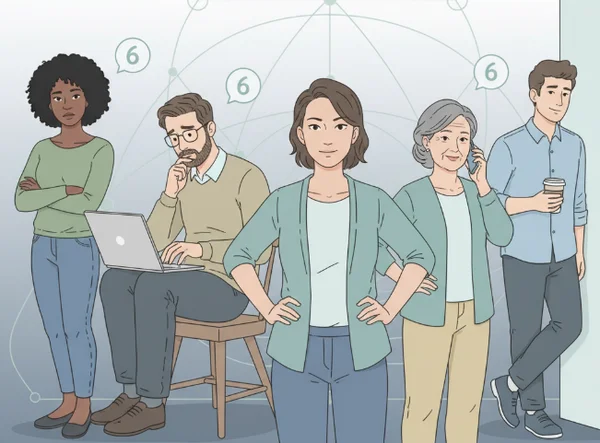
Have you ever met someone with the same Enneagram type as you, yet felt you were completely different people? Perhaps you are both Type 6, but while you worry about financial security, your friend is focused on social justice and group belonging. Why do people of the same type behave so differently?
The answer lies in Enneagram subtypes, also known as instinctual variants. These subtypes represent the "third dimension" of your personality. While your core type explains your basic fears and desires, your subtype explains where you direct your energy in daily life. Understanding these variations can help you move past surface-level descriptions and find deep, lasting growth.
The Enneagram isn't just a box to check—it's a living map of your inner world, revealing the intricate patterns that make you uniquely you. To begin this journey of self-discovery, you can take a high-quality enneagram test to identify your core patterns. Once you know your base type, exploring your instinctual variant is the next logical step toward total self-awareness.
What Are Enneagram Subtypes and Why They Matter
Enneagram subtypes are formed by the intersection of your core Enneagram type and one of three basic human instincts. You have all three of these instincts within you, but one usually dominates your attention and dictates your primary concerns. This dominant instinct colors how your personality type expresses itself in the world, often making two people of the same type look like polar opposites.
Understanding your subtype is crucial because it explains your "automatic" behaviors. It reveals what you prioritize when you are under stress and how you seek security. Without knowing your subtype, you might feel that a general description of your type doesn't quite fit. By identifying your instinctual variant, the Enneagram becomes a much more precise tool for your personal development.
The Three Instinctual Variants: Self-Preservation, Social, and One-to-One
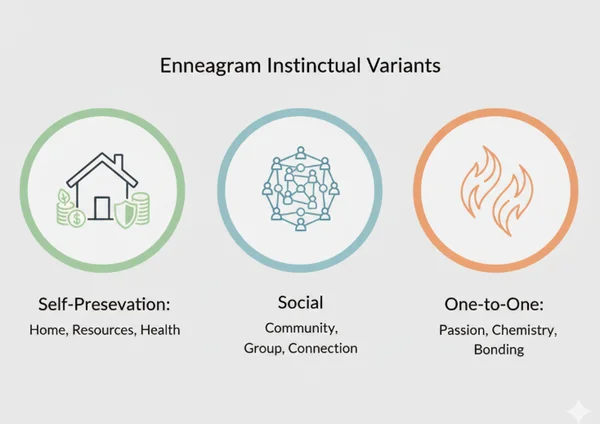
There are three primary instinctual variants that every human possesses. These are biological drives that you have inherited for survival, deeply rooted in the older parts of the human brain. To start your journey, you must first understand what these three drives look like in practice:
-
Self-Preservation (SP): This instinct focuses on physical safety, comfort, and health. It is the "nesting" instinct. If you have this dominant drive, you are likely very aware of your environment, resources, and bodily needs. You prioritize stability and the maintenance of life's basic requirements.
-
Social (SO): This instinct focuses on the group, community, and hierarchy. It is the "bonding" instinct. Those led by the social drive care about their role within a group and how they can contribute to the collective. You are naturally attuned to how you fit into the larger social fabric.
-
One-to-One (SX): Often called the "Sexual" instinct, this is about intense connection and chemistry. It is the "attraction" instinct. It isn't always about romance; it is about the drive for deep, high-energy fusion with people, ideas, or experiences. You seek the "spark" that makes life feel vivid and meaningful.
How Subtypes Create Unique Type Expressions
When an instinct combines with an Enneagram type, it creates a "subtype." Since there are nine types and three instincts, there are 27 distinct subtypes in total. This explains the huge variety you see within the same personality type.
For example, a "Social Type 4" might appear very different from a "Self-Preservation Type 4." While the core motivation of Type 4 is to find a unique identity, the Social 4 might express this through their role in a community, perhaps by being the "outsider" or the "creative" within a group. In contrast, the Self-Preservation 4 might express their uniqueness through their personal lifestyle and home environment, often suffering in silence while creating a beautiful aesthetic space. These variations are often called "counter-types" when the instinctual drive seems to go against the traditional description of the core type.
Identifying Your Dominant Instinctual Stack
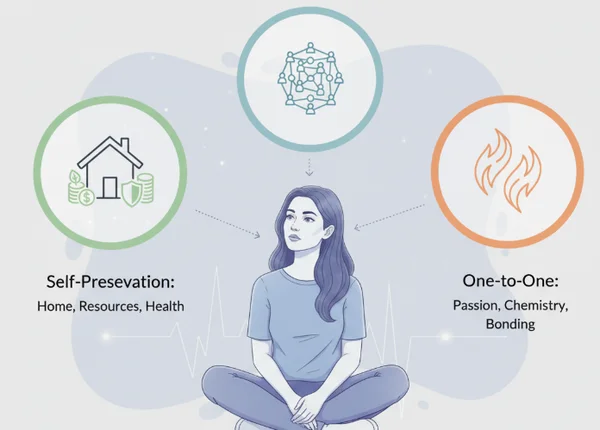
In Enneagram theory, you use the term "instinctual stack" to describe the order of your instincts. You have a dominant instinct (what you use most), a secondary instinct (which supports the first), and a "blind spot" (the instinct you often ignore). Identifying your stack is a powerful way to see where your life energy is flowing—and where it is blocked.
If you are unsure where you land, using a free online test can help you narrow down your core motivations. From there, you can look at the following signs to see which instinct feels most like home to you.
Signs of a Self-Preservation Dominant Subtype
If you are Self-Preservation dominant, your primary focus is on "well-being." You likely spend a lot of time thinking about your health, your bank account, and the comfort of your home. You might be the person who always knows where the nearest exit is or the one who ensures everyone has enough snacks for a road trip.
Common signs include:
- A strong need for "me time" and personal space to recharge your battery.
- Persistent anxiety about resources, such as money, food, or time management.
- A preference for predictable routines and physical safety over risk-taking.
- Focusing heavily on the domestic sphere, like home improvement, gardening, or cooking.
Characteristics of Social Instinct Variants
Those with a dominant Social instinct are "group-minded." You are naturally aware of the "vibe" in a room and the power dynamics between people. You want to know where you stand in relation to others. This doesn't necessarily mean you are an extrovert; it means you care about your impact on the community and how the community impacts you.
Key characteristics include:
- A strong interest in social causes, politics, or community leadership.
- Sensitivity to being included or excluded by a group or social circle.
- A desire to be "of service" or to have a meaningful, recognized role in society.
- High awareness of social norms, etiquette, and personal reputations.
One-to-One Instinct: Traits and Telltale Signs
The One-to-One (SX) instinct is about "intensity." If this is your dominant variant, you likely seek out experiences that make you feel truly alive. You are drawn to deep, soulful conversations and high-energy projects. You don't just want to be in a group; you want to find that one person or idea that you can fully merge with to feel a sense of completion.
Telltale signs of the SX variant:
- Searching for "the spark" in relationships, hobbies, and career projects.
- A tendency toward "all or nothing" energy—you are either 100% in or 100% out.
- Valuing chemistry and deep connection over social status or physical comfort.
- A restless drive to find something—a partner, a passion, or a spiritual path—that provides a sense of profound fusion.
How Your Subtype Influences Daily Life
Your subtype isn't just a psychological label; it dictates how you move through the world every single day. It influences who you date, how you act at work, and how you make difficult choices. By understanding these patterns, you can gain better control over your reactions and stop being a slave to your "automatic" drives.
I once worked with a couple who were both Type 9s. The husband was Social-dominant, constantly wanting to host neighborhood gatherings and join local committees. The wife was Self-Preservation-dominant, viewing their home as a sanctuary for rest and quiet. Before they understood their subtypes, they were constantly in conflict—he felt she was being "antisocial," and she felt he was "disrupting her peace." Once they identified their instinctual variants, they realized neither was wrong; they simply had different survival priorities. This insight allowed them to compromise without resentment.
Subtype Impact on Relationship Patterns
In relationships, instinctual variants are often the source of hidden conflict. If a Self-Preservation partner is focused on saving money for a house, and their One-to-One partner wants to spend that money on a spontaneous, high-intensity vacation, friction is inevitable. Neither is "wrong," but their instincts are pulling them in different directions.
Knowing your subtype helps you communicate your needs more effectively. An SX-dominant person can explain to their SO-dominant partner that they need more "quality time" without the distraction of friends. This level of insight is what makes the Enneagram such a powerful tool for career growth and personal harmony.
Career and Work Style Differences by Subtype
At work, your subtype determines your professional "brand" and how you interact with your colleagues.
- SP Subtypes are often the "stabilizers." They focus on the budget, the logistics, and making sure the office runs smoothly and predictably.
- SO Subtypes are the "networkers." They understand office politics, build alliances, and care deeply about the company culture and team morale.
- SX Subtypes are the "energizers." They bring passion to projects and are often the ones pushing for radical innovation or deep creative breakthroughs.
Recognizing these styles allows team leaders to place people in roles where their natural instincts can shine, leading to higher job satisfaction and better results.
Decision-Making Processes Across Subtypes
When faced with a big decision, your instinctual variant usually gets the first vote. When deciding whether to move to a new city, different instincts lead to different priorities. An SP-dominant person will focus on the cost of living. An SO-dominant person will consider the community and social opportunities. An SX-dominant person will ask, "Does this move excite me? Is there a sense of adventure there?"
By learning to balance all three instincts, you can make more holistic decisions. You can learn to listen to your "blind spot" instinct to ensure you aren't ignoring important parts of your life, like your physical health or your vital social connections.
Your Next Steps in Understanding Your Subtype Profile
As you explore your instinctual variants, you'll journey from surface-level awareness to profound self-understanding, unlocking the hidden motivations that truly drive you. You will begin to see why you prioritize certain things and how you can find more balance in your life. The Enneagram is more than a typing system; it is a roadmap for the rest of your life.
If you are ready to dig deeper, the best way to start is by getting an accurate profile of your personality. To see your results and explore how your instincts shape your world, visit our homepage. Our reports provide the specific, actionable insights you need to turn this knowledge into real-world growth and improved relationships.
The Takeaway
Can I have more than one dominant instinctual subtype?
It’s a common question, and the answer is both yes and no. Most Enneagram experts agree that while you use all three instincts, you typically have one dominant drive that leads your behavior. However, your secondary instinct is often quite strong and supports your dominant one. This ranking is what you call your "instinctual stack." You might feel a "tie" between two, but usually, one is the clear driver during times of stress.
How do I determine my instinctual stack if I relate to multiple subtypes?
If you're feeling a bit stuck, don't worry—most of us see a little of ourselves in every category because they are basic human needs. To find your dominant one, look at what you worry about most when things go wrong. If you worry about money or health first, you are likely SP. If you worry about your reputation or your place in the group, you are likely SO. You can also take a test to help clarify these patterns with objective data.
Are certain subtypes more common for specific Enneagram types?
Many people notice that some instincts naturally "align" with certain types. For example, Type 6 (The Loyalist) often has a strong Self-Preservation or Social drive because those instincts provide the security the type craves. However, any type can have any dominant instinct. These "unusual" combinations, like an SX Type 1 or an SP Type 7, often create the most interesting and complex personality profiles.
How do subtypes interact with wings in my overall personality profile?
Think of your core type as the foundation, your wings as the neighboring influences, and your subtype as the "flavor" or "color" of your energy. Your wing might change how you solve problems, but your subtype determines which problems you choose to solve first. For instance, a 9w1 with a Social subtype will be a very different person than a 9w8 with a Self-Preservation subtype.
Can understanding my subtype help me overcome specific challenges?
Absolutely. Most of your recurring problems come from your "blind spot" instinct—the one you neglect. If you find yourself constantly lonely, you might have a Social blind spot. If you find yourself always burnt out or physically exhausted, you might be ignoring your Self-Preservation needs. Recognizing these gaps allows you to consciously develop the areas you usually overlook, leading to a much more balanced life.