1 W 9 Enneagram: The Idealist Wing Explained
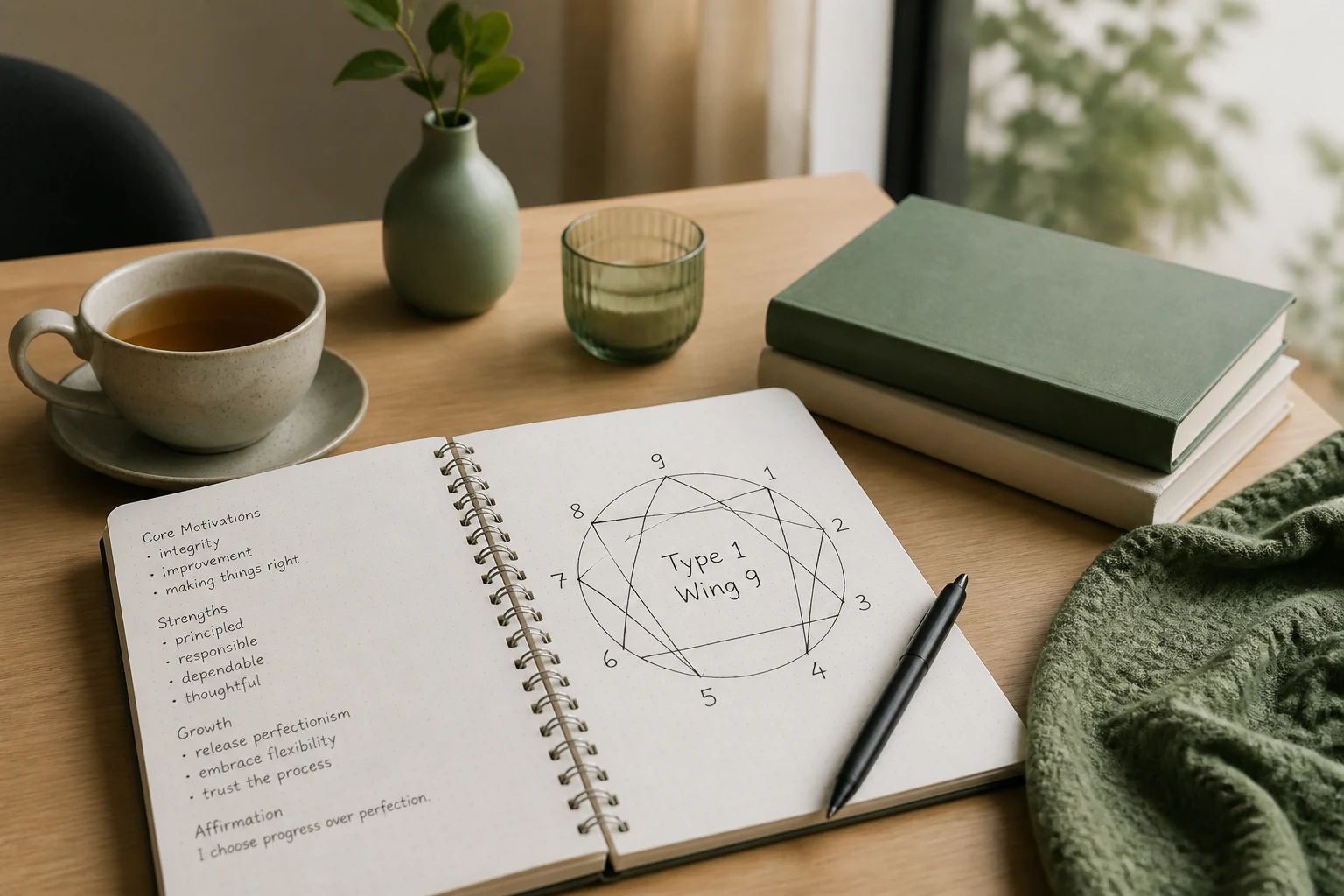
The 1 w 9 enneagram pattern describes a Type 1 core shaped by a Type 9 wing: principled, careful, improvement-focused, and often calmer than the more openly interpersonal 1w2. If Type 1 asks, "What is the right thing to do?" the 9 wing adds, "How can we keep the peace while doing it?" That blend can look thoughtful, restrained, quietly determined, and deeply loyal to values. For readers still sorting out their type, a structured Enneagram test for self-discovery can be a useful starting point, as long as the result is treated as a reflection tool rather than a final label.
What Is a 1 Wing 9 Enneagram Type?
A 1 wing 9 Enneagram type, often written as 1w9 or Enneagram 1 wing 9, is still primarily Type 1. The core motivation usually centers on integrity, responsibility, fairness, and improvement. The person wants to live by clear principles and may feel an inner pressure to correct what seems careless, wasteful, unjust, or poorly done.
The Type 9 wing softens how that drive appears. Instead of pushing every concern into direct confrontation, 1w9s often pause, observe, and look for a less disruptive way to improve things. They may prefer thoughtful essays over speeches, careful systems over emotional persuasion, and quiet consistency over public correction. This is why many descriptions call the 1w9 "The Idealist": the type combines a reformer's standards with a peacemaker's steadier presence.
It helps to remember that a wing is not a second core type. It is a neighboring influence. A 1w9 is not half Type 1 and half Type 9; the Type 1 pattern leads, while the 9 wing colors the style. Some 1w9s look intellectual and reserved. Others look warm but private. The shared theme is principled improvement expressed through calm, restraint, and a desire for inner and outer order.
Core Traits of the 1w9 Personality
The 1w9 personality often carries a strong internal standard. They notice errors quickly, care about doing work well, and may feel uncomfortable when rules are vague or values are compromised. At their best, this makes them reliable, fair-minded, and quietly courageous. They are often the person who reads the policy carefully, remembers the long-term consequence, and asks whether a decision matches the group's stated values.
The 9 wing adds patience and perspective. A 1w9 may be more willing than some Type 1s to consider multiple viewpoints before deciding what is right. They can be diplomatic, measured, and skilled at explaining principles without sounding combative. Their calm can help other people hear difficult feedback.
The challenge is that calm can become avoidance. Because 1w9s dislike both disorder and conflict, they may sit with frustration for too long. Instead of saying, "This bothers me," they may withdraw, become quietly stubborn, or focus on abstract principles while practical action stalls. Their growth often begins when they notice the difference between peacefulness and emotional disconnection.
Common 1w9 strengths include disciplined thinking, ethical consistency, careful listening, quality control, patience, and the ability to improve systems without making everything about personal drama. Common blind spots include suppressed anger, procrastination around tense conversations, perfectionism, and a tendency to judge themselves for ordinary human limits.

Enneagram 1w9 vs 1w2
The search phrase "Enneagram 1w9 vs 1w2" matters because both types share the same Type 1 core. Both may care about ethics, improvement, responsibility, and doing things correctly. The difference is the direction of the wing.
The 1w2 is influenced by Type 2, so their reforming energy often moves toward people. They may show love by helping, teaching, mentoring, or stepping in when someone needs support. Their style can be more expressive, relational, and service-oriented. When stressed, they may feel hurt if their efforts are not appreciated.
The 1w9 is influenced by Type 9, so their reforming energy often moves toward principles, systems, or quiet example. They may care deeply about people, but they usually prefer a calmer presence and a more indirect route. Instead of asking, "How can I help this person improve?" they may ask, "What structure would make this situation more fair, stable, or humane?"
In conflict, a 1w2 may engage more directly because relationship repair feels urgent. A 1w9 may retreat to think, hoping the right response will become clearer with distance. Neither style is better. The 1w2 may need boundaries around helping; the 1w9 may need practice with timely expression. Both grow when Type 1 standards become less punishing and more compassionate.
1w9 MBTI Patterns and INTJ Searches
Many people search for 1w9 MBTI matches, especially 1w9 INTJ. The two systems measure different things, so there is no fixed one-to-one match. The Enneagram focuses on motivation and coping patterns, while MBTI describes preferences in attention, decision-making, and energy. Still, some combinations can feel familiar.
INTJ 1w9 is a common search because both descriptions can include strategic thinking, independence, high standards, and a preference for improving systems. ISTJ 1w9 may show the same principled steadiness through duty, precision, and respect for proven methods. INFJ 1w9 may express ideals through quiet conviction, ethical insight, and a desire for humane change.
Other MBTI types can be 1w9 too. A person does not need to be introverted, intuitive, or highly analytical to have this Enneagram pattern. The better question is not "Which MBTI proves 1w9?" but "Do my recurring motives sound like Type 1 integrity filtered through Type 9 calm?" If yes, the pairing may be worth exploring in a broader Enneagram personality reflection.
Enneagram 1 Wing 9 Careers
Enneagram 1 wing 9 careers often fit best when the role rewards accuracy, fairness, and thoughtful improvement without constant chaos. A 1w9 may enjoy work where standards matter and where progress can be made through careful reasoning rather than nonstop persuasion.
Possible career themes include research, editing, law, compliance, architecture, engineering, quality assurance, education, public policy, environmental work, ethics-focused roles, data analysis, and operations. These are not prescriptions. A 1w9 can thrive in many fields when the environment gives them room to think, clear expectations, and a meaningful standard of excellence.
Workplace strengths often include noticing inconsistencies, documenting processes, improving systems, protecting quality, and staying composed when others rush. A 1w9 leader may be fair, consistent, and quietly respected. They may not enjoy performative enthusiasm, but they can build trust through clarity and integrity.
The risk is over-identifying with being the reasonable one. A 1w9 employee may silently carry frustration, delay hard feedback, or become disengaged when a workplace repeatedly compromises values. Practical growth at work can include naming concerns earlier, separating "imperfect" from "unacceptable," and choosing a few improvements that are realistic enough to complete.

1 W 9 Enneagram in Relationships and Love
In relationships, the 1 w 9 Enneagram pattern can be steady, loyal, and deeply considerate. These people may show care by being dependable, making thoughtful decisions, and trying not to burden others with unnecessary drama. They often value honesty, respect, shared principles, and a peaceful home or friendship dynamic.
In love, a 1w9 may not always lead with intense emotional display. Affection can appear as practical support, careful listening, consistency, and a desire to build something honorable together. They may be drawn to partners who respect their need for quiet reflection and who can discuss problems without escalating every disagreement.
The tender issue is unspoken resentment. Because Type 1 notices what is wrong and Type 9 resists disruption, a 1w9 may minimize irritation until it leaks out as distance, coolness, or moral disappointment. Partners may sense that something is wrong but not know what to address. The healthier move is simple but difficult: say the concern while it is still small.
Compatibility is not determined by Enneagram numbers alone. A 1w9 can build a strong relationship with any type when both people practice curiosity, responsibility, and repair. Helpful questions include: What standard am I holding silently? What peace am I protecting? What honest sentence would reduce distance instead of creating more?
Female 1w9 and Character Examples
Searches for "1 w 9 enneagram female" and "1 w 9 enneagram characters" usually come from people looking for recognizable patterns. Gender does not determine Enneagram type, and fictional characters are interpretive examples rather than evidence. Still, the 1w9 style can show up in women or female characters who are principled, composed, private, and quietly firm about justice or correctness.
A female 1w9 may be praised for maturity, self-control, and good judgment while privately feeling pressure to be beyond reproach. She may become the responsible one in a family, team, or friendship group. Because her 9 wing softens direct anger, other people may underestimate how strongly she feels about fairness, quality, or moral consistency.
In fiction, 1w9-coded characters often serve as the calm conscience of a story. They may be judges, teachers, guardians, strategists, editors, investigators, or idealistic leaders who resist corruption without needing the spotlight. The useful question is not whether a character is "officially" 1w9. It is what their pattern can teach about values, restraint, and the cost of staying silent for too long.

Growth Tips for a Healthy 1w9
Healthy 1w9 growth is not about becoming less principled. It is about making principles more livable. The goal is to keep integrity while loosening the inner pressure that says every flaw must be corrected before rest is allowed.
First, practice naming anger as information. Anger does not have to become attack. It can simply reveal that a boundary, value, or need has been crossed. A 1w9 who can say, "I am frustrated because this standard matters to me," often becomes warmer and clearer than one who silently withdraws.
Second, choose action over perfect theory. The 9 wing may prefer waiting until all sides are considered, while the Type 1 core may want the response to be flawless. A small, imperfect next step can be healthier than another week of internal debate.
Third, build rest into the standard. If the only acceptable version of yourself is endlessly composed and useful, the standard itself needs revision. Rest, play, and honest connection are not distractions from integrity. They are part of a sustainable life.
Finally, use type language lightly. The Enneagram can support reflection, but it should not become a box. If you want a broader view of your core type, wing possibilities, and growth themes, EnneagramTest.me offers growth-oriented Enneagram insights that can help you explore patterns without treating them as fixed destiny.

How to Explore Your 1w9 Pattern Next
The 1 w 9 enneagram pattern is best understood as a living question: where do your standards help you create goodness, and where do they distance you from your own needs? If the Type 1 core gives you a devotion to what is right, the 9 wing can help you bring that devotion with patience, humility, and calm.
For a next step, compare your real behavior across ordinary situations: feedback, conflict, deadlines, relationships, and rest. Notice whether you move toward direct helping like 1w2, quiet principled improvement like 1w9, or a different pattern entirely. You can also review an accessible Enneagram self-awareness tool as one input among many, then keep what supports honest growth.
FAQ
What is a 1 wing 9 Enneagram?
A 1 wing 9 Enneagram is a Type 1 core influenced by Type 9. The Type 1 side brings integrity, responsibility, and a drive to improve. The Type 9 wing adds calm, patience, restraint, and a preference for peaceful problem-solving. Together, the pattern often looks principled, thoughtful, and quietly idealistic.
Is 1w9 the same as 9w1?
No. A 1w9 has a Type 1 core with a 9 wing, while a 9w1 has a Type 9 core with a 1 wing. A 1w9 is usually driven by correctness and integrity first. A 9w1 is usually driven by inner peace and harmony first, with a secondary concern for goodness or order.
What is the difference between Enneagram 1w9 vs 1w2?
Both share the Type 1 core, but the wing changes the style. A 1w9 tends to be calmer, more reserved, and more focused on principles or systems. A 1w2 tends to be more relational, expressive, and focused on helping people directly. Both can be caring and ethical in different ways.
What MBTI is most likely to be 1w9?
There is no certain MBTI match for 1w9. Commonly discussed pairings include INTJ, ISTJ, and INFJ because they can share traits like seriousness, independence, structure, and idealism. However, MBTI and Enneagram describe different layers of personality, so any MBTI type can explore whether 1w9 motives fit.
What careers fit Enneagram 1 wing 9?
Many 1w9s prefer careers that reward careful thinking, ethical standards, and system improvement. Examples can include research, editing, law, compliance, engineering, education, public policy, operations, and quality-focused work. Fit depends on skills, values, environment, and personal circumstances, not type alone.
What are 1w9 relationships like?
1w9 relationships are often loyal, steady, and thoughtful. A 1w9 may show care through reliability, honesty, and practical support. The main relationship challenge is speaking up before frustration becomes distance. Direct but gentle communication helps the 1w9 stay connected without abandoning their standards.
Is an Enneagram 9w1 unhealthy?
Any Enneagram type or wing can be healthy, average, or strained. A 9w1 is not unhealthy by default. When strained, a 9w1 may avoid conflict, numb out, or become quietly judgmental. When healthy, they can be grounded, patient, principled, and deeply calming to others.
What is the childhood trauma of Enneagram 9?
No single childhood experience proves someone is Type 9. Some Type 9 descriptions discuss learning to keep peace, minimize needs, or avoid disruption, but personality patterns are shaped by many factors. It is safer to treat childhood themes as reflection prompts, not as proof or clinical guidance.